
The 2026 content benchmark: what 140 blogs show
Our content benchmark read 140 small business blogs in 2026. What they publish, what they skip, and the habits that set the strongest blogs apart.

The Larkspur content benchmark is our yearly look at how small companies that sell to other businesses run their blogs. During August 2026, 140 of their public blogs went through our hands. We read each one post by post and counted what any reader can see: who wrote each post, when it was last updated, how it answers its question and where its numbers come from.
This is the summary. Members get the full tables by category.
Five findings from the content benchmark #
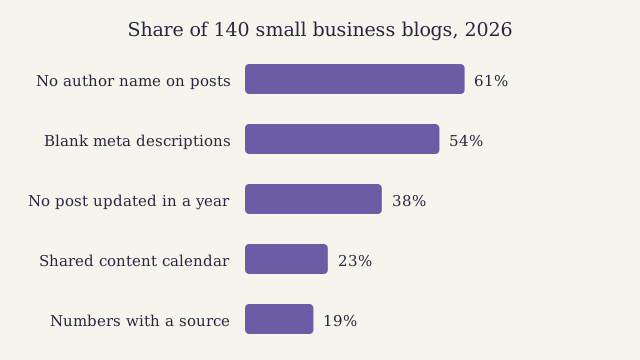
The share of the blogs we read that showed each habit. The longest bar is a gap, not a strength: most blogs left out the author's name.
| Finding | Share of blogs |
|---|---|
| No author name on posts | 61% in 2026 |
| Meta description blank on at least one post in five | 54% in 2026 |
| No post updated in twelve months | 38% in 2026 |
| A content calendar shared with the whole team | 23% in 2026 |
| Numbers in posts linked to a source | 19% in 2026 |
Who wrote this post #
Readers trust a person more than a logo, and search engines look for signs that a real expert stands behind a page. Even so, most blogs we read in 2026, 61% of them, showed no author at all. Fewer still had an author page with the writer's experience.
The fix takes an afternoon: a name on each post, a short bio, and a page per writer that says why they know the subject.
The forgotten archive #
The most common habit we found was neglect. Blogs kept publishing, but they rarely went back. In 2026, 38% had not changed a single post in the past twelve months, including posts that named prices or tools that no longer exist.
We cannot prove the update caused every extra click. Posts worth updating may have been stronger to begin with. But the pattern held in every category we read, and it matches what we see with clients. Our playbook for posts that slipped shows how to choose which ones to update first.
Planning and pace #
The median blog in our sample published, in 2026, 2 posts a month, usually in bursts followed by long gaps. Only 23% in 2026 used a content calendar shared with the whole team. The blogs with a shared plan published at a steadier pace and had fewer gaps longer than two months.
If your team plans in a chat thread, our guide to a calendar a small team can keep is a gentle place to start.
The parts searchers see first #
Titles and descriptions are the first thing a searcher reads, and many blogs left them to chance. In 2026, 54% of the blogs left the meta description blank on at least one post in five. Search engines then write their own snippet from the page, which rarely sells the click.
Titles fared better, but many were vague labels like "Our thoughts on pricing". Our post on headlines that earn the click shows what works instead.
Sources and AI search #
Only 19% of the blogs in 2026 linked their numbers to a source. That matters more each year. AI search tools prefer passages that state a fact plainly and show where it comes from, so an unsourced number is less likely to be quoted. Read how AI search picks which pages to quote for the full picture, and our guide to writing for AI search for what to change. Sample rows from this study are now free to download.
The rest of this post is for subscribers, and signing up is not open here.
What the content benchmark means for your blog #
Four gaps, ranked from the cheapest to close.
You do not need to fix everything at once. Pick the gap that is cheapest to close:
- Add author names and bios. An afternoon of work, and it helps every post at once.
- Refresh your best old post. Start with the one that once did well and has slipped.
- Write the missing descriptions. Ten minutes per post, and you choose what searchers read.
- Share one calendar. One sheet the whole team can see, with an owner per post.
Measure the effect the same way we do: count the cost and the results, post by post. Our guide to return on content shows how.
For a much larger view of how content teams work, the Content Marketing Institute's research publishes yearly surveys of marketers.
Signing up by email is not open on this site.
By Priya Raman. Published .
About the author

Research editor at Larkspur Studio
Experience MSc in Statistics, runs the yearly Larkspur content benchmark
Priya turns questions about content into numbers you can trust. She designs the yearly Larkspur content benchmark, checks every statistic we publish against its source, and writes about measuring what content earns and how AI search chooses what to quote.
Reviewed by